


















Digital Literacy Has Changed: Knowing When NOT to Trust Technology
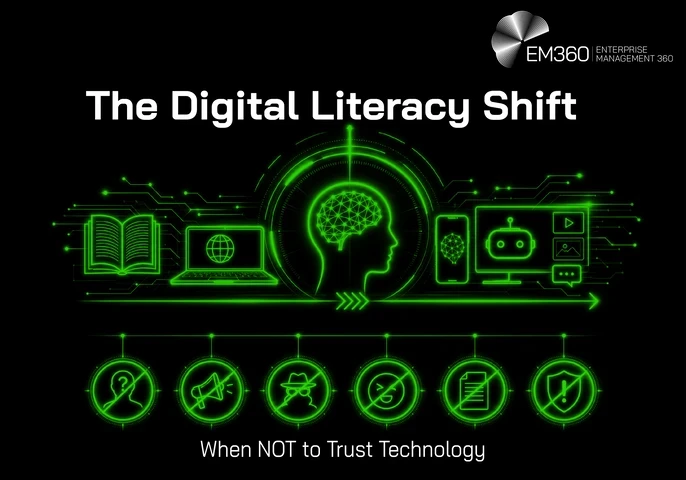
The most important digital skill may no longer be knowing how to use technology, but knowing when its answers need to be questioned.

“Agents are changing that game, because who owns the agent is now becoming much more critical,” Soumya Banerjee, SailPoint, on why AI agents in production need a named human owner.


Dr. Joe Perez is a powerhouse in the IT and education worlds, with 40-plus years’ experience and a wealth of credentials to his name. From Business Intelligence Specialist at NC State University to Senior Systems Specialist/Team Leader at the NC Department of Health & Human Services (and Chief Technology Officer at CogniMind), Perez is at the forefront of innovation and process improvement. With more than 22,000 LinkedIn followers and a worldwide reputation as keynote speaker, data management/analytics expert, and prolific, bestselling author, Perez is a highly sought-after resource in his field. He speaks at many conferences each year, reaching audiences in over 20 countries across the globe and has been highly-ranked by prestigious Thought Leader communities. He was recently inducted into both the IIBA Hall of Fame and the United Nations Global Network of Data Officers and Statisticians and was selected to be a Distinguished Fellow in the Public Sector Network's Future Government Institute. When Dr. Joe is not working, he shares his musical talents and gives back to his community through his involvement in his church's Spanish and military ministries.
Discover expert led podcasts, articles, and news from enterprise technology leaders at EM360Tech, your source for B2B tech intelligence
The most important digital skill may no longer be knowing how to use technology, but knowing when its answers need to be questioned.


We look at when AI infrastructure accumulates enough authority to require the stronger security controls used for privileged systems.

Harrison Kim described Samsung as one of the largest-scale deployments of ChatGPT anywhere in the world, with employees in Korea and overseas using it for research and development, marketing and sales.
In this guide, we'll break down what Google Analytics actually tracks, how the platform has changed, and why getting it right matters.
We look at why AI-powered SQL is forcing data teams to balance query cost, latency and answer quality in new ways.

Could AI change the way organisations buy and build business software?

China's tech giants have launched new foldable smartphones, intensifying competition in the premium handset market just days before Apple is expected to unveil its very first foldable iPhone.

We look at why AI productivity may increasingly depend on how much machine work people can direct, verify and keep under control.
We cover the bizarre $320M Liquid Network hack, from the apparent Elements vulnerability and patch timeline to the attackers promising to return most of the Bitcoin.
"The next era will be defined as much by the identity and authorisation plumbing around the models as by the models themselves: which agents exist, who they act for, what they are allowed to do, and how that can be proven after the fact."
We explore why modern infrastructure is becoming harder to audit, and what organisations need to preserve accountability as systems change.

We explore why scalable quantum networking may depend on integrating quantum capabilities with the telecom infrastructure already in place.

We look at why frontier AI control is moving beyond developers as governments, independent evaluators and neutral institutions take a bigger role.

Nepal's flood response shows how real-time access to technical knowledge can become critical when traditional records and infrastructure are buried or destroyed.

Perishables introduce constant risk, demand fluctuates hour by hour, and margins leave almost no room for error. These conditions make manual processes fragile and generic retail tools insufficient.
AI is moving into live business operations, speedy real-time analytics helps keep the view on changing conditions to support timely, reliable decisions.

We explore how AI data centres are bringing power generation, storage and compute orchestration into one coordinated infrastructure system.


“If you had to use AI simply to make your product easier, it probably wasn’t easy to work with to begin with,” Randy De Meno.
We report on OpenAI's plans for automated AI shutdown capabilities following the Hugging Face security incident.
We'll break down how that stack is actually built, from ingestion through to the serving layer, the architectural patterns enterprises are choosing between and what tends to go wrong once the pipeline is live and someone's dashboard doesn't match finance's spreadsheet.

We explore why hardware security is moving beyond component inventories towards provenance, attestation and verifiable trust across the hardware lifecycle.


How data governance, semantic layers and consistent metric definitions can prevent confident AI-driven data errors.
Get the latest insights, analysis and tech news delivered straight to your inbox
Filters